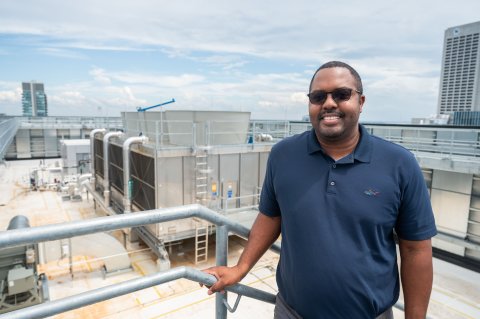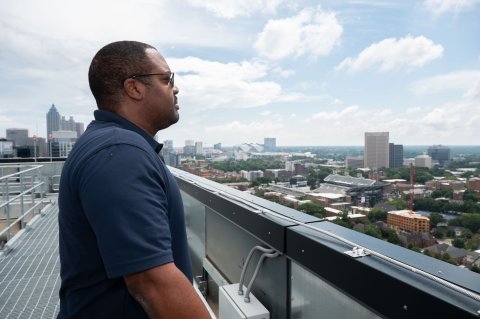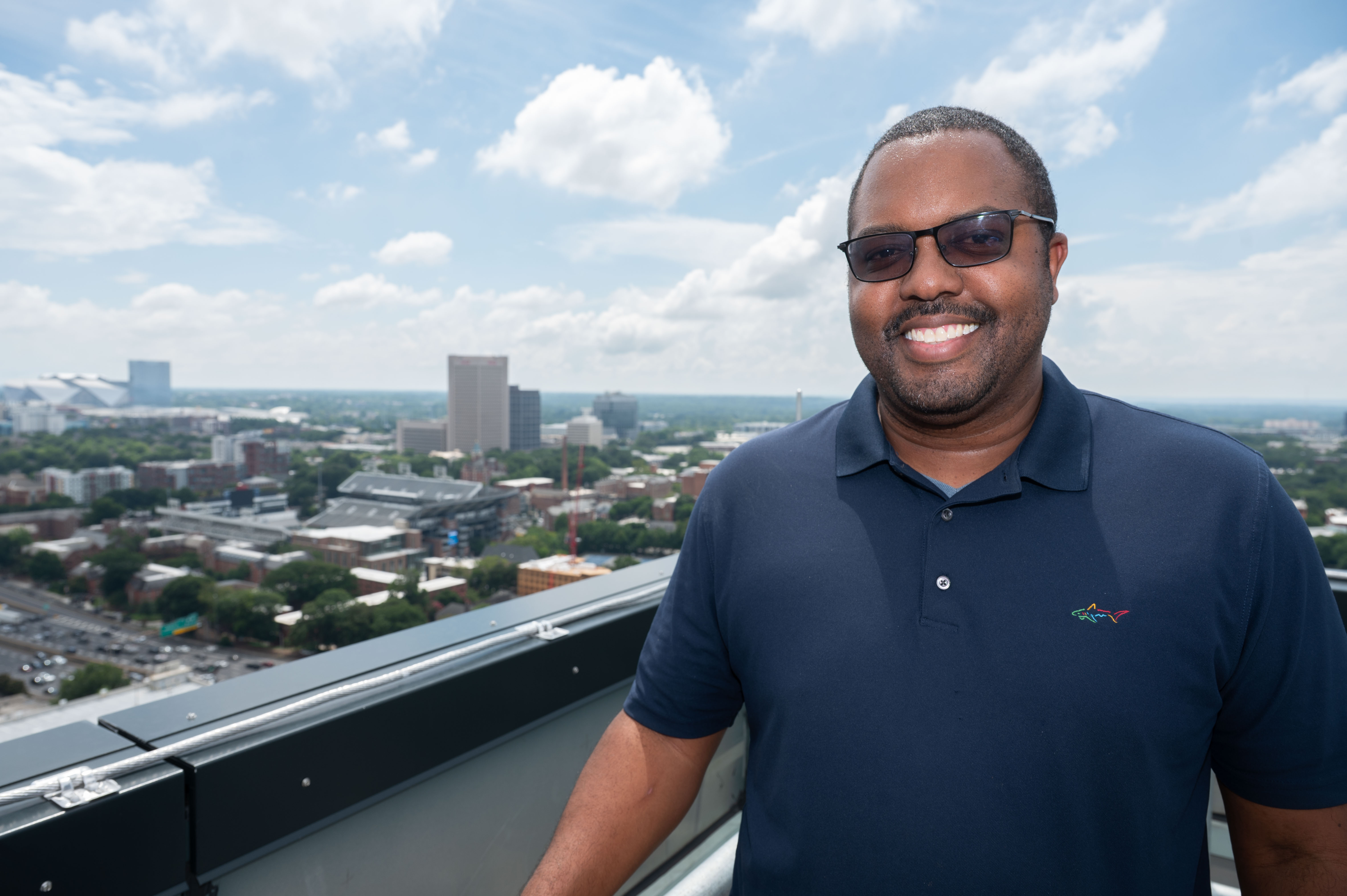
Infrastructure and Operations Associate Director of Utilities Management Jermaine Clonts photographed on the roof of the George Tower in Tech Square August 2026.
While often unnoticed, the work of Jermaine Clonts and the Utilities Management team is essential to delivering the utility services that power teaching, learning, research, and campus life.
Most members of the Georgia Tech community rarely think about campus utilities, and that's exactly how Jermaine Clonts likes it.
As associate director of Utilities Management within Infrastructure and Operations, Clonts and his team work around the clock to ensure that students, faculty, staff, and researchers have reliable access to electricity, heating, cooling, and water. While much of that work happens out of sight, it plays a critical role in supporting every aspect of campus life.
"In the utilities business, no news is usually good news," said Clonts. "Most people don't think about heating, cooling, electricity, or water until something stops working."
Keeping Campus Running
Clonts oversees the utility infrastructure that helps keep Georgia Tech operating every day. His responsibilities include managing the Institute's district energy systems, which generate heating and cooling for buildings across campus, as well as overseeing relationships with utility providers and vendors.
His team also tracks energy consumption, benchmarks building performance, identifies conservation opportunities, and supports both Georgia Tech's Climate Action Plan and long-term utility planning efforts.
While many assume that universities simply purchase utilities from outside providers, Clonts says Georgia Tech's operation is much more complex.
Tech operates two central district energy plants that generate heating and cooling for a large portion of campus. Beneath the sidewalks, roads, and green spaces lies an extensive network of underground pipes that distribute chilled water for cooling and steam for heating to campus buildings.
"It's infrastructure that works every day to keep campus comfortable and operational," Clonts said.
No Such Thing as a Typical Day
Because Georgia Tech operates 24 hours a day, seven days a week, there is no ordinary day in utilities management.
Clonts usually begins each morning by reviewing the status of utility systems and district energy plants to ensure they are meeting campus demands. Any equipment issues, outages, or operational concerns immediately become top priorities.
Once critical operations are addressed, his work shifts toward long-term improvements.
"Whether we're responding to an emergency, making campus more resilient, identifying ways to operate more efficiently, advancing sustainability goals, or planning infrastructure that will support Georgia Tech for the next decade, there's always something new to tackle," he said.
Supporting Every Corner of Campus
From residence halls and classrooms to research laboratories, athletic facilities, and offices, reliable utility systems make teaching, learning, research, and campus experiences possible.
Managing those services comes with unique challenges.
One of the largest is the diversity of campus facilities, where each building, lab, or athletic facility comes with different operational needs. The age of campus infrastructure adds another layer of complexity, with some buildings featuring modern, energy-efficient systems while others have served the Institute for decades.
The need to maintain uninterrupted service for critical operations makes planning and maintenance even more important.
Advancing Sustainability Through Energy
Many of Georgia Tech's sustainability goals are directly connected to the work of utilities management.
"Our greenhouse gas inventory is heavily influenced by two key areas: the natural gas we use for heating and the electricity we purchase to power campus operations," Clonts said.
One initiative he is especially excited about is the electrification of heating systems and transportation.
The Institute is working to reduce reliance on fossil fuels by transitioning building heating systems to technologies such as heat-recovery chillers and expanding the use of electric vehicles across campus. Infrastructure and Operations also regularly invests in energy efficiency improvements, including lighting upgrades and HVAC system optimization.
"This transition supports Georgia Tech's Climate Action goals, improves efficiency, and helps reduce local air pollutants," Clonts said.
Technology is also changing the way utility systems are managed. Smart meters and advanced metering infrastructure now provide real-time utility data, allowing Clonts' team to monitor building performance more closely, identify unusual usage patterns, and make better-informed decisions.
"We're also seeing significant innovation in heat pump and heat recovery chiller technologies," he said. "These systems can simultaneously provide heating and cooling while recovering energy that would otherwise be wasted."
Letting Data Drive Decisions
Data and analytics have become essential tools for Utilities Management.
By analyzing utility consumption and building performance, the team can identify trends, prioritize projects, and maximize the impact of investments. "Instead of relying on assumptions, we use real data to help prioritize projects and investments that will have the greatest impact," Clonts said.
Smart meters, building automation systems, and automated alerts also allow the team to quickly detect equipment issues and respond before they become larger problems.
The Importance of Water Conservation
While energy often dominates sustainability conversations, Clonts believes water conservation deserves more attention.
Atlanta's history of drought challenges and the city's relatively high water and sewer costs make conservation efforts both environmentally and financially important. Residence halls are among the largest water users on campus outside of district energy plants, creating a significant opportunity for students to help make a difference.
Simple actions, such as taking shorter showers, reporting leaks, and being mindful of daily water use, can have a meaningful impact when multiplied across thousands of students.
"Water conservation is a sustainability effort where small individual actions can add up quickly," Clonts said.
A Living Campus
For students interested in careers related to infrastructure, energy, engineering, or sustainability, Clonts encourages curiosity and hands-on learning. "Georgia Tech is a mini city," he said. "Every day you're surrounded by a diverse range of buildings, transportation networks, and utility infrastructure."
He believes that understanding how campus infrastructure works helps people recognize how much goes on behind the scenes and how individual actions contribute to a more sustainable campus. Ultimately, that behind-the-scenes work is what motivates him and his team every day.
"What many people don't see is all the planning, monitoring, maintenance, and coordination that happens every day to keep problems from occurring in the first place," Clonts said. "When everything is working as it should, people can focus on teaching, learning, research, and campus life."
Additional Images